


In earthwork loading operations, poor coordination between excavators and transport trucks commonly manifests as waiting for trucks, waiting for buckets, frequent reversing, or the bucket failing to align with the truck bed during dumping. Many buyers' first reaction is "the machine is not big enough" or "the bucket is not big enough," but the loading rhythm is determined jointly by the excavator, transport trucks, site layout, and material conditions. Attributing all problems to the host machine's tonnage can easily lead to selecting a machine that is too large or too small.
This article focuses on a specific question: in scenarios where medium-to-large crawler excavators handle loading tasks, how should the matching boundaries between the equipment and the transport fleet be judged? Using the publicly available information on this site's SH240-8 as the parameter basis, it explains which characteristics correspond to loading requirements and which conditions are not covered by the information and need separate confirmation.
First look at the actual constraints of loading operations
Whether loading coordination is smooth is usually affected by the following types of conditions, not just digging force:
- Material condition: ordinary earthwork, hard soil, weathered rock, or loose material have different requirements for bucket penetration and lifting.
- Transport truck specifications and parking position: bed height, length, and reversing position affect dumping height and swing angle.
- Site layout: whether the excavator's standing position and the transport truck passage are separated, and whether there are obstacles within the swing radius.
- Fleet rhythm: the number of transport trucks and the round-trip cycle determine whether the excavator loads continuously or waits frequently.
- Ground bearing capacity: whether soft soil or backfill areas cause track sinking and affect standing stability.
Among these conditions, the first four determine "whether loading can be smooth," and the fifth determines "whether the machine can stand securely." Looking only at excavator tonnage cannot answer any of them.
Host machine conditions to verify for loading coordination
Translating the above constraints into equipment conditions, they can be roughly grouped into four categories:
| Operating constraint | Corresponding equipment condition | Why it is relevant |
|---|---|---|
| Material hardness and bucket fill level | Bucket capacity, bucket and stick digging force | Determines penetration difficulty and material load per bucket |
| Transport truck bed height and parking distance | Maximum dumping height, maximum digging reach | Determines whether dumping requires position adjustment |
| Site swing space | Tail swing radius, minimum swing radius of working equipment | Determines operating margin near adjacent vehicles and obstacles |
| Standing position on soft ground or backfill areas | Ground pressure, track shoe width | Determines whether the standing position is stable and prone to sinking |
This table is only a judgment sequence, not a selection formula. Each item must be valued according to specific site conditions, and on-site data not included in the information cannot be inferred from parameters.
Which loading requirements do the SH240-8 specifications correspond to
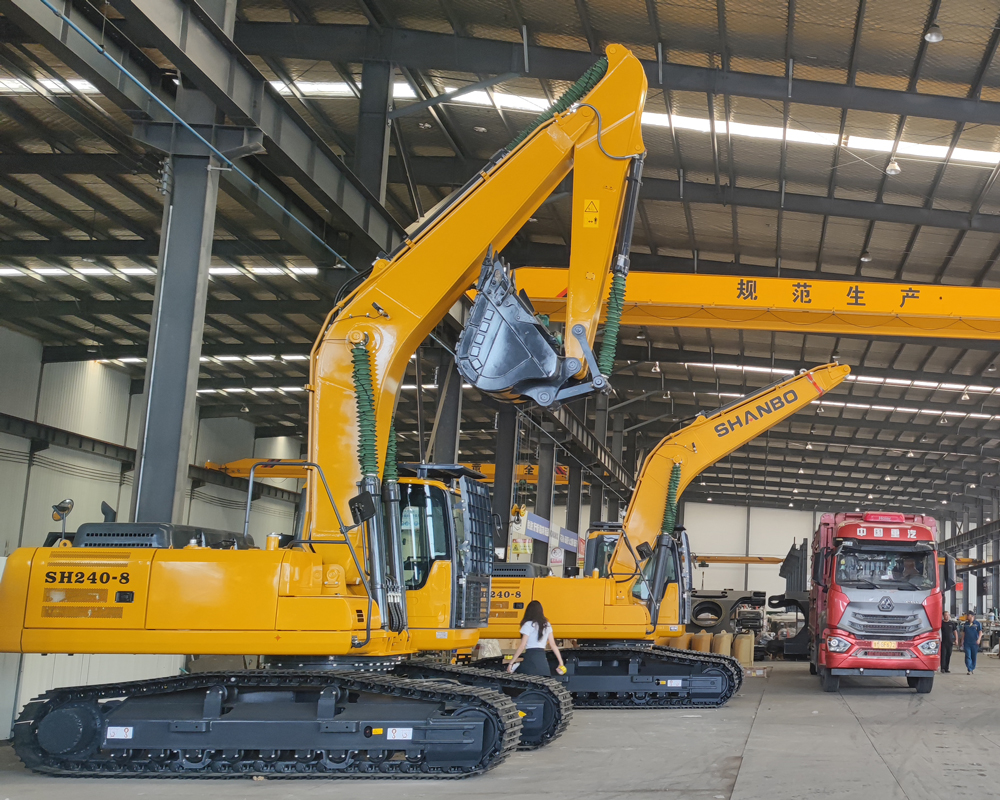
The SH240-8 is a 23.2-ton medium crawler excavator on this site, equipped with a Cummins 6BTAA5.9 engine, rated power 133 kW/2000 rpm, standard bucket capacity 1.2 m³, bucket digging force 146 kN, and stick digging force 107 kN. If the loading target is conventional earthwork, backfill soil, or loose material, this configuration can serve as a starting point for discussing loading coordination; if the material is harder or contains many stones, the bucket type and actual penetration performance need further verification.
Dumping height and truck bed alignment
This model's maximum dumping height is 7190 mm, maximum digging height 10095 mm, maximum digging reach 9860 mm, and maximum digging reach at ground level 9675 mm. For common dump truck bed heights, these data provide margin for dumping alignment; however, the specific transport truck bed height, parking distance, and site elevation differences still need on-site measurement. The values in the information are equipment capability limits and do not mean that smooth dumping at that height is possible every time in actual operation.
Swing space and adjacent vehicle layout
The tail swing radius is 2920 mm, and the minimum swing radius of the working equipment is 2970 mm. During loading, if the transport truck and excavator standing positions are close, or if there is a slope or wall on one side of the site, these two values can help judge whether there is a safety margin during swinging. However, personnel passages and vehicle dispatch methods within the swing radius still need to be determined by on-site layout and cannot be judged from parameters alone.
Standing position on soft ground and backfill areas
This model's ground pressure is 49.8 kPa, track shoe width 600 mm, total track width 2800 mm, and 9 track rollers per side. When loading on backfill soil or sites with high moisture content, ground pressure is one of the reference items for judging whether sinking is likely. However, whether 49.8 kPa is suitable for a specific site also depends on soil type, moisture content, and compaction degree. The information does not provide these corresponding relationships, so confirmation should be made based on geological survey or on-site testing before purchase.
Continuous operation and refueling rhythm
Fuel tank capacity is 330 L, and hydraulic oil tank capacity is 250 L. If loading operations involve continuous shifts and tight transport truck turnover, refueling intervals will affect operational continuity. This value can help estimate refueling arrangements within a shift, but actual fuel consumption is affected by material, operating habits, and idle time. The information does not include fuel consumption data, so specific operating costs cannot be calculated from it.
Matching boundaries on the transport truck side
Loading coordination is not determined unilaterally by the excavator. The ratio of transport truck bed volume to bucket capacity, vehicle parking method, and reversing passage width all change the loading rhythm. A common judgment sequence is:
- First determine the transport truck model and bed dimensions, then calculate whether the number of bucket loads per truck is reasonable;
- Then confirm whether the excavator's swing angle and dumping height are within a comfortable range after the transport truck is parked;
- Finally check whether the number of trucks matches the excavator's single-bucket cycle time, avoiding "trucks waiting for buckets" or "buckets waiting for trucks."
The information on this site does not provide the complete operating cycle time of the SH240-8, nor does it give matching conclusions for specific transport truck models. Therefore, the above sequence can only serve as a communication framework before purchase and cannot replace on-site trial matching.
Conditions under which the model or configuration needs reconsideration
The SH240-8 information points to scenarios such as conventional earthwork, heavy construction, and road engineering. If the following conditions occur, the selection judgment needs to be re-verified rather than directly applying this model:
- The material is mainly hard rock and requires frequent breaking or strong penetration;
- The transport truck bed height clearly exceeds the conventional range, or the parking distance exceeds the maximum digging reach;
- The site is extremely narrow, and the tail swing radius and working equipment swing radius do not satisfy adjacent vehicle layout;
- The ground is extremely soft mud or a slurry layer, and ground pressure needs re-evaluation;
- Continuous multi-shift operation is required and refueling conditions are limited, requiring separate calculation of tank capacity and refueling arrangements.
The above conditions do not mean the model is unsuitable, but indicate that these boundaries have no direct conclusions in the information and need confirmation with the manufacturer or on-site technical personnel.
Checklist before purchase
- Material type, moisture content, maximum lump size, and whether a breaker attachment is needed;
- Transport truck model, internal bed dimensions, bed height, and planned parking method;
- Ground conditions at the excavator standing position, whether it is a backfill area, soft soil, or slope;
- Single-shift operating time, number of transport trucks, and round-trip cycle;
- Whether there are slopes, overhead lines, buildings, or personnel passages within the swing radius;
- Whether the bucket type matches the material, and whether other bucket types need to be confirmed with the manufacturer.
Operating information to provide when requesting a quotation
When requesting a quotation from a manufacturer or dealer, it is recommended to provide: material type and volume, transport truck model and bed dimensions, site layout plan and ground conditions, planned shifts and construction period, whether breaking or other attachments are needed, and local fuel supply conditions. The more specific the information provided, the more helpful it is to judge whether a 23.2-ton medium excavator such as the SH240-8 falls within a reasonable range for loading coordination, and which configurations need further confirmation.